
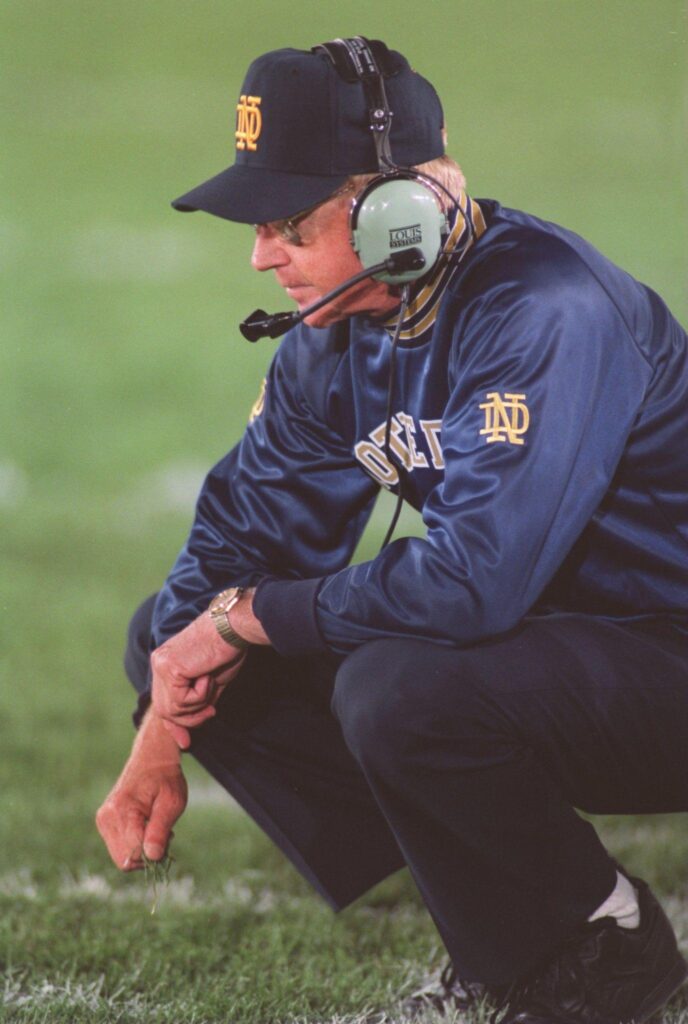
Hall of Fame college football coach Lou Holtz, best known for leading the Notre Dame Fighting Irish to a national championship and later becoming a prominent television analyst, has died at the age of 89. His passing marks the end of one of the most influential careers in college football history.
Holtz’s death was confirmed by family members and organizations connected to his long career in football and broadcasting. The coach, who spent decades shaping the game both on the field and in the media, leaves behind a legacy that touched generations of players, fans, and commentators.
A Coaching Career That Spanned Decades
Holtz built a coaching résumé that few in college football history can match. Over the course of his career, he served as head coach at multiple major programs, including Arkansas Razorbacks, Minnesota Golden Gophers, South Carolina Gamecocks, and Notre Dame.
But it was in South Bend, Indiana, where Holtz cemented his reputation as one of the sport’s most successful leaders.
According to records maintained by the National Football Foundation, Holtz led Notre Dame to the 1988 national championship and compiled a 100–30–2 record during his tenure with the program.
His teams were known for disciplined play, strong defense, and a physical running game that helped define Notre Dame football during the late 1980s and early 1990s.
The 1988 National Championship Season
Holtz’s crowning achievement came during the 1988 season, when Notre Dame finished undefeated and captured the national title.
That year, the Fighting Irish defeated the top-ranked Miami Hurricanes in a historic matchup widely remembered as one of the defining games of the era.
The victory helped propel Notre Dame to the national championship and solidified Holtz’s place among the elite coaches in college football history.
According to the National Football Foundation, the 1988 team remains one of the most celebrated squads in Notre Dame history.
Transition to Broadcasting
After retiring from coaching in 2004, Holtz transitioned into broadcasting and became a familiar voice to millions of football fans.
He joined ESPN, where he served as a college football analyst for several years.
Holtz became known for his passionate commentary, distinctive voice, and deep knowledge of the sport.
His television career introduced him to a new generation of fans who knew him not as a coach on the sideline, but as a commentator breaking down the game each Saturday.
Honors and Recognition
Holtz’s contributions to football earned him numerous awards and recognitions.
He was inducted into the College Football Hall of Fame in 2008, cementing his status as one of the sport’s most influential figures.
Over his career, Holtz compiled more than 240 wins as a college head coach, placing him among the winningest coaches in NCAA history.
Former players frequently credited him not only for football success but also for the life lessons he emphasized during their time under his leadership.
Tributes Pour In
Following news of his passing, tributes began pouring in from across the sports world.
Former players, coaches, and broadcasters praised Holtz for his leadership, mentorship, and commitment to the game.
Notre Dame officials described him as a defining figure in the university’s football tradition and credited him with restoring the program to national prominence during his tenure.
Sports commentators also highlighted Holtz’s impact beyond coaching, noting his ability to connect with audiences as a broadcaster and public speaker.
A Lasting Legacy
Few figures in college football have left a mark as lasting as Lou Holtz.
From championship seasons at Notre Dame to decades of influence in the sport, his career spanned multiple eras of college football.
Players who once ran through tunnels under his leadership went on to become coaches, analysts, and leaders in their own right.
While the game of college football continues to evolve, the lessons Holtz preached—discipline, preparation, and perseverance—remain core principles in programs across the country.
His voice may be gone from the sidelines and the studio, but his influence on the sport is likely to endure for generations.