
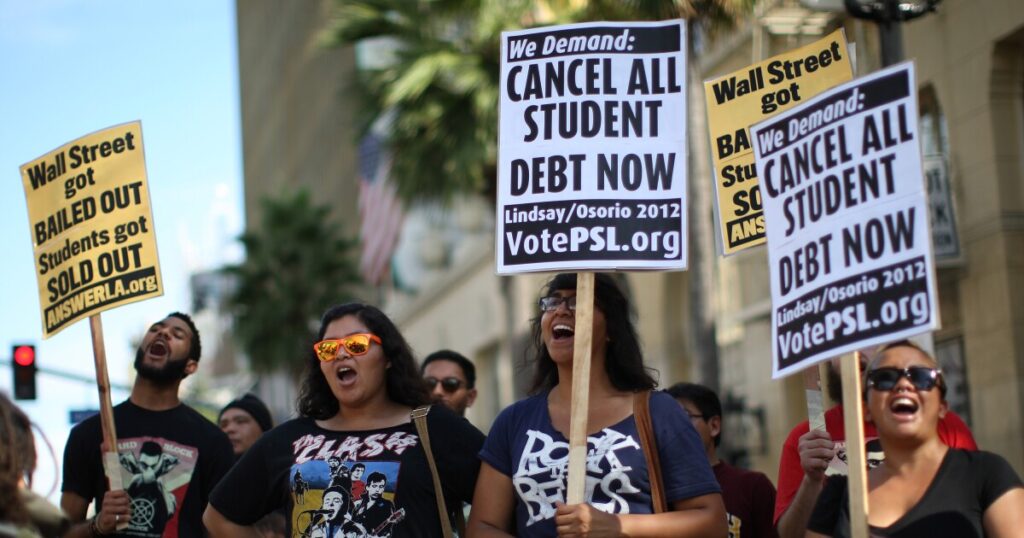

Federal student loan forgiveness has once again become a major political and economic debate in the United States as lawmakers, courts, and policymakers clash over how — or whether — the government should provide relief to millions of borrowers. With student debt levels remaining historically high and new legal developments reshaping federal programs, the issue continues to divide voters, economists, and political leaders.
The debate centers on whether canceling or reducing federal student loan debt would provide economic relief for struggling borrowers or unfairly shift financial responsibility onto taxpayers. According to education and financial policy analysts, the outcome could affect tens of millions of Americans and reshape how higher education is financed in the future.
Student Loan Debt Remains a Massive National Issue
Student loan debt has grown dramatically over the past two decades and is now one of the largest forms of household debt in the United States. Financial analysts note that more than 42 million Americans collectively owe over $1.6 trillion in federal student loans, making it a central issue in national economic policy discussions.
Economists and policy researchers cited by The Week say the burden of student debt can delay major financial milestones such as buying a home, starting a business, or saving for retirement, particularly for younger Americans entering the workforce. These concerns have fueled calls from some policymakers to reduce or cancel portions of the debt through federal action.
Supporters argue that loan forgiveness would help borrowers regain financial stability and stimulate economic activity by freeing up money for consumer spending and investment.
Legal Battles Continue Over Federal Relief Programs
Recent court rulings have added new uncertainty to the student loan debate. A federal judge recently allowed the Saving on a Valuable Education (SAVE) repayment plan to continue after legal challenges threatened to shut it down, according to reporting from Business Insider.
The SAVE plan, originally introduced to reduce monthly payments and eventually allow loan forgiveness for certain borrowers, currently affects millions of Americans enrolled in income-driven repayment programs. Business Insider reported that roughly 7.4 million borrowers remain enrolled in the program, although legal disputes and policy changes have slowed its implementation.
Despite the court decision allowing the program to proceed for now, its long-term future remains uncertain as lawmakers and federal agencies continue debating potential reforms.
Supporters Say Forgiveness Could Boost the Economy
Advocates for student loan forgiveness argue that reducing or eliminating federal loan balances would help millions of borrowers recover financially after years of rising tuition costs.
Economic policy experts cited by the Peter G. Peterson Foundation say supporters believe debt relief would allow borrowers to spend more money in the broader economy, potentially boosting business activity and consumer spending.
Supporters also argue that student debt has disproportionately affected younger Americans and minority borrowers who often carry larger loan balances relative to their income.
For many advocates, loan forgiveness is viewed as a necessary step toward addressing the rising cost of higher education and reducing financial pressure on college graduates.
Critics Warn of Cost and Fairness Concerns
Opponents of widespread student loan forgiveness argue that canceling debt could create significant economic and fairness concerns.
Policy analysts cited by the Congressional Digest say critics believe forgiving large amounts of debt would shift the financial burden onto taxpayers, including people who never attended college or who already repaid their loans.
Some economists also argue that the benefits of forgiveness may disproportionately help higher-income borrowers who attended graduate or professional schools and carry larger loan balances.
Other critics warn that broad debt cancellation could encourage colleges to continue raising tuition costs if students believe future loans may eventually be forgiven.
A Deep Political Divide
Public opinion on student loan forgiveness remains sharply divided along political lines. Surveys conducted by the Associated Press-NORC Center for Public Affairs Research show that support for federal student debt relief varies significantly depending on political affiliation.
According to polling data cited by the AP-NORC Center, a majority of Democratic voters view loan forgiveness as an important policy goal, while Republican voters are far less supportive of canceling student debt.
These differences have made student loan forgiveness a recurring issue in national political debates, particularly during election cycles when candidates outline their economic and education policies.
The Future of Student Loan Relief
For now, millions of borrowers remain uncertain about what future federal policies may bring. Legal battles over repayment programs, new proposals in Congress, and potential changes to federal education policy continue to shape the debate.
Education policy experts say the long-term solution may ultimately require broader reforms to the cost of college itself. Without addressing rising tuition prices, some analysts warn that student debt could continue to grow even if forgiveness programs provide temporary relief.
A Debate That Isn’t Going Away
The debate over federal student loan forgiveness touches on broader questions about economic fairness, government responsibility, and the rising cost of higher education. With trillions of dollars in debt and millions of borrowers affected, the issue remains one of the most consequential policy discussions in the United States.
As courts, lawmakers, and federal agencies continue shaping the future of student loan programs, the debate is likely to remain at the center of national political and economic conversations for years to come.